

The cyclone aftermath: How NOT to challenge a government

By Kassapa
When the results of the November 2024 general election emerged, it became apparent that the National People’s Power (NPP) had secured a stunning victory, virtually wiping out the parliamentary opposition. Since then, the opposition has been sniping at the ruling party, but they have been unable to create a lasting impact. Now, they believe Cyclone Ditwah has provided them with the perfect opportunity.
Amidst accusations that the government was either ignorant of warnings about the cyclone in international media or chose to ignore them, the death toll was staggering, over 600, with nearly a tenth of the country’s population affected. This, the opposition believes, is a fertile ground for it to launch its plan of action.
Taking the lead is the United National Party (UNP) and its leader, former President Ranil Wickremesinghe. He accuses the government of negligence and said this was “actionable in the Supreme Court”. This appears to be the line the UNP is taking. Its lawyers are reportedly studying ways and means of laying charges on the government. Clearly, Wickremesinghe wants to put President Anura Kumara Dissanayake in the dock, even if it is after he leaves office, in what seems to be a tit-for-tat exercise.
Wickremesinghe complains that the declaration of Emergency Regulations came late and that announcing a public holiday was detrimental to rescue efforts, and both contributed to an increased death toll. This, from a man who was sanctioned by the Supreme Court for imposing Emergency Regulations while he was Acting President!
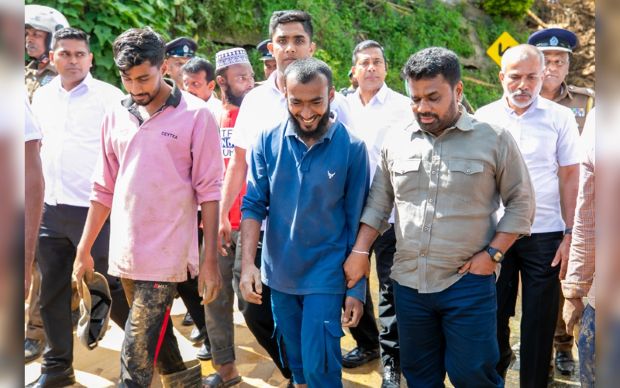
Meanwhile, Dissanayake has been very busy. He met with opposition parties represented in Parliament and addressed the nation while personally supervising the rescue effort. He fervently appealed to the opposition to ‘leave politics for later’. This was followed by a series of meetings at the district level, where he appeared knowledgeable and astute when he questioned officials and formulated relief plans.
To top it all, Dissanayake wound up the Budget debate in his capacity as Finance Minister and unveiled a rescue package that had many gasping in disbelief. It was as comprehensive as it was costly, but Dissanayake was confident that the money could be found. Indeed, the donations were coming in thick and fast, perhaps fuelled by the still unblemished reputation of the NPP as being free from corruption.
Enter, Sajith Premadasa. He takes to visiting affected people, notebook in hand, on Monday, December 8 and asks whether they received the funds promised by Dissanayake on Friday, December 5. Inevitably, the answer is ‘no’. ‘I will intervene and ensure that you receive it,’ Premadasa says, all for the benefit of the cameras. This scenario is repeated ad nauseam. This is broadcast on mainstream and social media.
While this might make good theatre with Premadasa in the hero’s role, it left many with the question as to whether Premadasa doesn’t have enough intelligence to surmise that measures announced by a government on Friday will not be implemented by Monday. Or, is it that he realizes this but is playing to the gallery anyway? Neither is salutary to the reputation of the Leader of the Opposition and the leader of the Samagi Jana Balavegaya (SJB).
The SJB is also keen to pursue legal action against the government. Its spokesman, S.M. Marikkar, who is often seen as Premadasa’s voice, threatened to do so at a media briefing, comparing the Cyclone disaster with the 2019 Easter terror attacks vis-à-vis government inaction despite warnings. Marikkar was asked whether the opposition too had a moral duty to inform the public if it was aware of these warnings, and he smugly replied that ‘it was not the job of the opposition’.
The line of attack of the other major opposition party, the Sri Lanka Podujana Peramuna (SLPP) has also been to accuse the government of being ill-prepared. It’s de facto leader Namal Rajapaksa is touring affected areas and meeting people with cameras faithfully recording his every move. Rajapaksa regularly accuses the government of mishandling the relief effort as well and says the government should learn from his uncle, Gotabaya Rajapaksa, about disaster management. That, and his father’s track record during the 2004 tsunami disaster, has evoked many a humorous response.
The government must certainly answer questions about its disaster preparedness and whether more pre-emptive action was possible, raising the possibility that if this were done, it might have saved more lives at least. Inquiries must be hel,d and if necessary, those responsible should be held accountable.
Nevertheless, as Dissanayake said, the time for that is not now. It is not merely sad but tragic that not a single mainstream opposition leader, Wickremesinghe, Premadasa and Rajapaksa included, is able to rise above petty political divisions and announce that they will support the government and ask searching questions later. This is while Dissanayake is criss-crossing the country, visibly tired but soldiering on, meeting with officials and attending to the needs of those affected. He is rising in the popularity stakes while the troika from the opposition are steadily falling.
The most ringing endorsement for Dissanayake came from an unexpected source- Chandrika Kumaratunga. The Bandaranaike Foundation, which she heads, donated 250 million rupees for the relief effort, presented personally by Kumaratunga to Prime Minister Harini Amarasuriya. This is also a slap in the face to other opposition leaders because the message it delivers is two-fold. Firstly, it reflects the fact that Kumaratunga trusts Dissanayake and his administration with a substantial donation.
Secondly, it also highlights that while she is able to support a government led by a party which stood accused of murdering her husband and also asked her to leave her official residence not long ago, her colleagues in the opposition are hellbent only on seeking political advantage at a time of tragedy. It is a telling blow for the UNP, the SJB and the SLPP.
So, the politics of Cyclone Ditwah continues. By its actions so far, the opposition has collectively and without a doubt demonstrated that it wants to take maximum political advantage from it. If indeed the government’s relief effort succeeds, then it is the opposition that could be swept away when the next major elections, the provincial polls, are held next year.
-This article was originally featured on counterpoint.lk

Comments are closed, but trackbacks and pingbacks are open.